Sound and Vision: How David Bowie Taught a Generation to Create Without Fear
When I first heard David Bowie it felt like light cutting through the static. His voice painted pictures and shaped a generation’s creative edge. He showed me that being different is not a flaw, it is a declaration, and that made all the difference.

The first time I heard David Bowie, I was sitting in the back seat of my parents’ car. “Starman” came through the radio, and even at that age, I knew it was different. His voice didn’t just sing; it painted pictures in my head. I remember looking out the window, feeling like I’d been invited somewhere else entirely. That moment changed something in me, even if I couldn’t name it yet. I didn’t understand art, rebellion, or identity, but I understood wonder.
As I grew up, Bowie was always there, shaping the edges of my imagination. He wasn’t just background music. He was a presence. For a kid who felt like an outsider too creative, too introspective, too odd Bowie was proof that being different wasn’t a flaw. It was a signal.
The Blueprint of Reinvention
What always drew me to Bowie wasn’t only the music. It was his ability to become someone new without losing his truth. One year he was Ziggy Stardust, the next he was the Thin White Duke, and later he was creating atmospheric art rock in Berlin. Each version of him was fearless. He built and destroyed identities with precision, never clinging to one long enough to become predictable.
That idea became the blueprint for how I think about creativity. Reinvention isn’t betrayal; it’s growth. Every campaign I’ve built, every brand I’ve developed, every pivot I’ve made in my career echoes that lesson. Creativity doesn’t thrive on repetition—it thrives on curiosity. Bowie didn’t reinvent himself to shock people; he did it to stay honest. He evolved because stagnation was worse than failure.
I’ve had my own moments of creative burnout, where everything starts to feel mechanical. Whenever that happens, I think about Bowie in Berlin, stripped of fame and glamour, surrounded by synthesizers and risk-takers like Brian Eno. He built a new sound from the ground up by allowing chaos to lead. That discipline of reinvention is what saved him. It’s also what keeps me going when the creative well runs dry.
The Sound That Shaped Gen X
By the time Nirvana covered “The Man Who Sold the World” on MTV Unplugged, Bowie had already shaped a generation he never directly belonged to. I remember watching that performance and feeling something click. It wasn’t nostalgia—it was connection. The torch had passed. Bowie’s DNA was in every note.
Scott Weiland carried that same spirit. You could hear Bowie’s fingerprints in the way Weiland changed personas between albums, balancing confidence and fragility. Even his stage presence had that same shimmering contradiction: self-assured yet haunted.
For Gen X creatives like me, that connection wasn’t about imitation. It was about permission. Bowie made weirdness feel noble. He made it safe to mix vulnerability with swagger. He gave an entire generation a template for self-expression that wasn’t confined by category or expectation.
That attitude still drives me. Whether I’m shaping a campaign for a brand or sketching out ideas for a personal project, I chase that same balance—structure meets rebellion, science meets soul. Bowie’s sound taught me that rules can guide you but should never cage you.
Fearlessness as a Creative Discipline
Bowie’s process fascinates me because it wasn’t random. He wasn’t a chaotic genius drifting from idea to idea. He worked within structures that forced creativity to bloom in unexpected ways. The Oblique Strategies cards he used with Brian Eno were a set of prompts designed to disrupt predictable thinking. “Use an old idea,” one might say. “Honor thy error as a hidden intention.” That mindset is the opposite of fear. It’s creative faith.
I’ve learned to adopt that same principle in my work. When something feels off or uncertain, that’s often where the best ideas are hiding. Bowie wasn’t afraid of failure because he understood it was part of the process. That’s why Low was considered strange at release but later seen as revolutionary.
His courage wasn’t loud. It was intentional. He took artistic risks without asking for approval. That’s a lesson that still cuts deep for me. In a professional world obsessed with metrics, it’s easy to mistake validation for value. Bowie never needed the chart position to confirm his worth. He trusted the work. That trust is something I try to carry every time I create.
Style, Identity, and Permission to Be Different
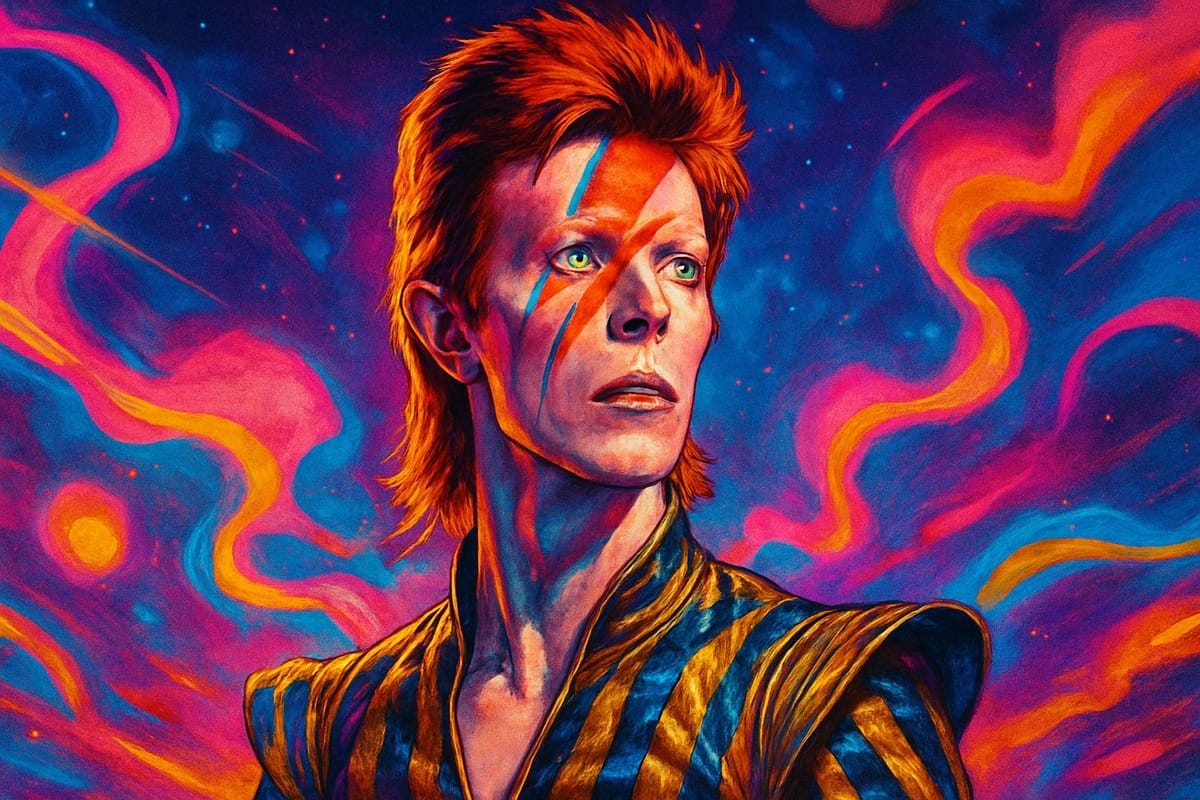
Bowie’s visual style was more than costume it was communication. He didn’t dress up to perform; he dressed up to tell the truth. When he painted that lightning bolt across his face, he was declaring that identity could be an art form. For those of us growing up in an era that prized conformity, that was liberation.
I remember the first time I saw footage of Ziggy Stardust. It felt dangerous, but not in a destructive way. It was dangerous because it was free. Bowie didn’t care who understood him; he cared that the art was honest. That energy made me realize that creativity isn’t about pleasing people it’s about showing them what you see.
In my career, I’ve had to navigate corporate spaces where creativity is often reduced to checklists and approval chains. Bowie’s defiance reminds me that true artistry can exist even in structured environments. You can push boundaries respectfully. You can stay authentic even when you’re playing in someone else’s sandbox.
He gave me permission to show up fully as myself quirks, flaws, contradictions, all of it. I learned that personal branding isn’t about polish; it’s about honesty. Bowie didn’t pretend to be perfect. He showed us that identity is fluid, and creativity thrives when we stop trying to freeze ourselves into one version.
Blackstar and the Final Lesson
When Blackstar arrived, I was older, but Bowie’s impact hit even harder. I didn’t know he was dying at the time, but something about that album felt like closure. It was strange, haunting, beautiful, and fearless. Only later did I realize it was a goodbye disguised as art.
That moment reshaped how I think about legacy. Bowie wasn’t just saying farewell; he was teaching one last lesson create with purpose until the end. That idea stuck with me more than any motivational quote ever could.
It made me think about what I leave behind with every project, every design, every written word. Am I making something that matters, or just something that works? Bowie didn’t settle for functional. He aimed for timeless.
There’s a quiet strength in knowing your work might not be understood right away. That’s something I’ve come to embrace. Not every creative risk pays off immediately, but the ones that do often define your voice. Bowie’s final act was proof that authenticity outlasts approval.
The Thread Between His World and Mine
I often wonder what Bowie would think of the world now. The speed of content, the constant pressure to perform, the endless demand for relevance it feels like everything he warned us about. Yet his lessons still hold. Reinvent, stay curious, stay brave.
When I launched my own creative projects, I found myself thinking about that kid in the car, listening to “Starman.” That feeling of wonder never left. It evolved into a career built on curiosity, storytelling, and design. Bowie taught me that art isn’t about escape—it’s about connection. Every great idea still carries a trace of that signal from somewhere beyond the ordinary.
Even now, when I stare at a blank screen trying to find the right words or the right direction, I think of Bowie in his Berlin apartment, piecing together something new from fragments of noise and emotion. He wasn’t chasing trends; he was chasing truth. That’s what I want to do too.
Carrying the Spark Forward
Bowie’s influence lives on in everything that values courage over comfort. It’s in every artist who dares to evolve, every designer who chooses originality over imitation, every leader who values creativity as an act of faith. For me, it’s personal. His work didn’t just inspire me it shaped how I see the world.
He taught me that art doesn’t belong to the elite. It belongs to anyone willing to be vulnerable enough to make it. Creativity isn’t about control; it’s about surrender. Bowie understood that better than anyone.
I don’t listen to his music as background noise. I listen to it like a conversation. Each era of his career feels like advice whispered from one creator to another. Be bold. Be strange. Be real. It’s a message that keeps me grounded when I start overthinking everything.
Final Thoughts
David Bowie didn’t just make music; he made possibility feel real. He proved that art could be intelligent, theatrical, and deeply human all at once. He showed me that identity is not fixed, creativity is not a formula, and fear is not a wall—it’s a door.
When I look at my own path, I see the imprint of his courage everywhere. I see it in every risk I’ve taken, every pivot I’ve made, every time I’ve chosen honesty over ease. Bowie’s lesson is simple but transformative: you can build a life around art and still remain human.
He once said, “I don’t know where I’m going from here, but I promise it won’t be boring.” That line sits on my desk as a quiet reminder. The goal isn’t to be understood immediately; the goal is to stay alive creatively.
For me, Bowie’s music is more than nostalgia it’s instruction. It’s a reminder that fear is the enemy of innovation, and reinvention is how we stay awake in our own lives.
If Bowie ever changed the way you think about art, identity, or creativity, tell someone. Share his music, his interviews, his courage. Tell them he wasn’t just a rock star. He was a roadmap for what it means to live honestly through creation.